
This structure is consistent across all regulations
BSA / AML
OFAC/ Sanctions
Fraud Testing
FCRA Testing
FCPA / ANTI-BRIBERY TESTING
MODEL RISK (SR 11-7)
THIRD-PARTY RISK (FINCRIME VENDORS)
GOVERNANCE & OVERSIGHT
ABC
KYC / CDD
Transaction Monitoring
QA & Validation
— Former CustomerFinancial Crimes & Regulatory Testing, Built the Way Regulators Think
I design financial crimes testing programs by starting where regulators start: the regulation, the risk it creates, and how controls fail — not just whether a box was checked.
My framework translates regulatory requirements into inherent and residual risk, maps expected and actual controls, defines how each control should be tested, and documents executable test steps and failure modes across AML, sanctions, fraud, and consumer protection.
The result is a single, defensible testing universe that supports regulator exams, audit committees, and executive decision-making.
Designed for global banks, complex regulatory environments, and high-risk financial activity.
How I Approach Financial Crimes Testing
Financial crimes testing is an assurance discipline. Like accounting, it is designed to test both completeness and accuracy — applied to regulatory obligations instead of financial statements.
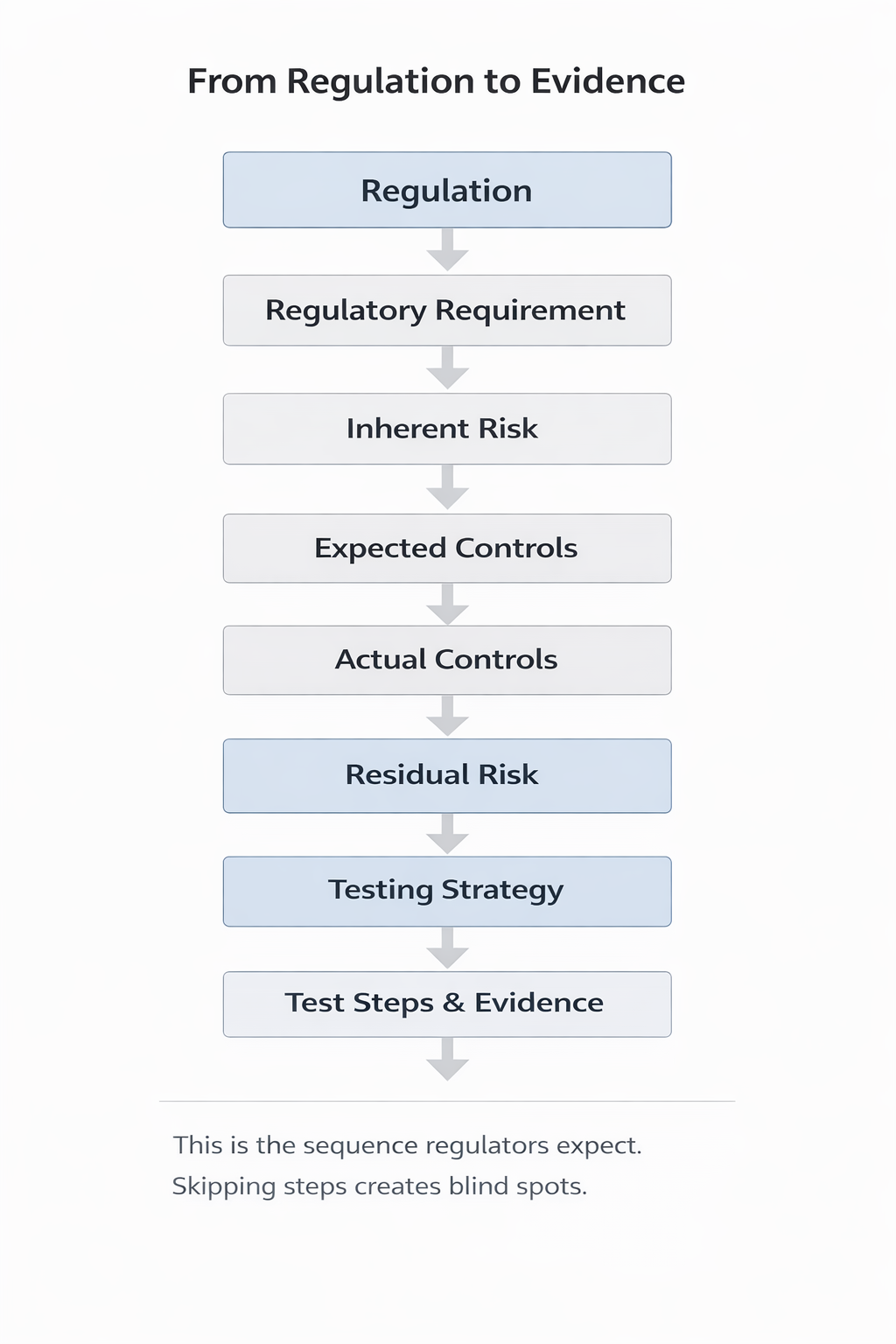
Why This Sequence Matters
This sequence is intentional. Regulators do not start with testing results — they start with the rule, the risk it creates, and whether controls are designed and operating effectively to mitigate that risk.
Testing that skips directly to samples or outcomes without anchoring back to regulation and risk produces false comfort and missed exposure.
Tracing vs. Vouching (Completeness vs. Accuracy)
In financial crimes testing, completeness is tested by tracing activity forward — from customer or transaction, through controls, to regulatory outcomes.
Accuracy is tested by vouching backward — from reported outcomes to supporting evidence and underlying activity.
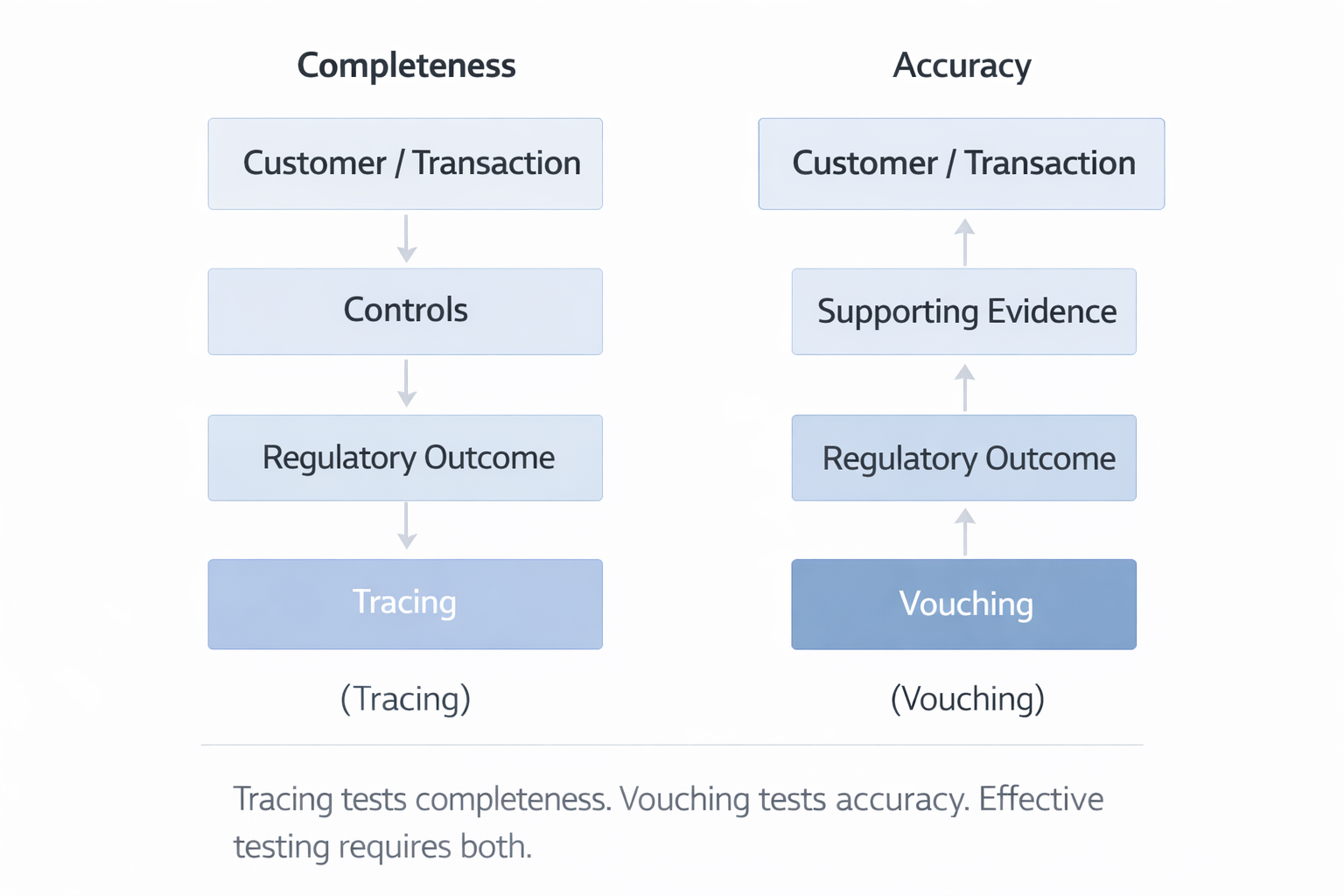
Why this matters
Regulators routinely find deficiencies where testing focuses on outcomes without validating completeness, or where samples are reviewed without confirming population coverage. Tracing and vouching together provide defensible assurance that regulatory obligations are both fully captured and accurately executed.
BSA / AML Testing Playbook (Example)
Below is an example of how this framework is applied to BSA / AML obligations in practice.
Regulatory Anchor
Primary regulation: Bank Secrecy Act (31 CFR Chapter X)
Regulators: FinCEN, Federal Reserve, OCC, FDIC
Regulatory objective: Detect, prevent, and report suspicious activity and illicit financial behavior
Key Risk Areas
Failure to identify suspicious activity
Incomplete transaction monitoring coverage
Ineffective customer risk rating
Untimely or inaccurate SAR filings
Weak escalation and case management controls
Inherent Risk Assessment
Inherent risk is driven by:
Customer types and geographies
Products and services offered
Transaction volume and velocity
Use of automated monitoring models
Reliance on third-party data sources
High inherent risk requires broader coverage and deeper testing.
Expected Controls
Customer risk rating and segmentation
Automated transaction monitoring scenarios
Alert generation and queue management
Analyst review and escalation procedures
SAR decisioning, preparation, and filing
Management oversight and quality assurance
Actual Controls Evaluated
Automated monitoring rules and thresholds
Case management workflows
Manual analyst review and disposition
Supervisory review and approval
SAR filing and FinCEN submission controls
Controls are classified as automated or manual to determine testing approach.
Residual Risk Determination
Residual risk reflects:
Control design effectiveness
Control operating effectiveness
Degree of manual judgment
Volume of exceptions or overrides
Residual risk directly informs testing frequency and depth.
Testing Strategy
Testing is designed to address both completeness and accuracy:
Tracing (Completeness):
Start with customer or transaction populations
Confirm coverage by monitoring scenarios
Verify alerts are generated and reviewed
Confirm escalation to SAR decisioning where appropriate
Vouching (Accuracy):
Start with SARs and closed cases
Validate supporting transaction data
Confirm rationale, documentation, and approvals
Trace back to underlying customer activity
Testing Methodology
Automated controls:
Eligible for 100% population testing using system data
Manual controls:
Risk-based sampling using judgmental or statistical methods
Judgmental decisions:
Scenario-driven review and rationale assessment
Sample Test Steps
Obtain population of in-scope customers and transactions
Confirm inclusion in monitoring scenarios
Recalculate alert logic and thresholds where applicable
Review alert disposition and escalation timeliness
Validate SAR decision rationale and documentation
Confirm SAR filing accuracy and timeliness
Assess management review and QA results
Evidence Retained
Transaction data extracts
Alert and case logs
Analyst notes and escalation records
SAR filings and confirmations
Management review and QA reports
Failure Modes Addressed
Transactions not captured by monitoring
Alerts improperly closed
Escalations delayed or unsupported
SARs not filed when required
Insufficient documentation to support decisions
Outcome
A defensible testing conclusion that demonstrates:
Full population coverage
Accurate regulatory reporting
Traceability from regulation to evidence
Readiness for regulatory examination